AI Data Center Energy Consumption: Causes, Costs and What Comes Next

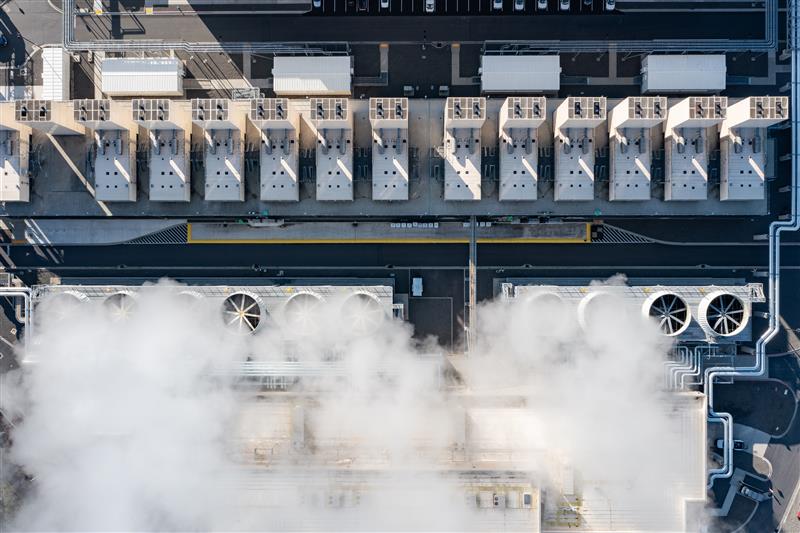
Our AI ambitions are being out paced by our lack of surplus energy. Will the bubble burst or will big tech and governments find a way to keep the chips and the cooling systems working?
Data centers are now consuming over 4% of grid power in the US, up from 1.9% in 2020. AI takes most of the credit for all that extra power, demanding more compute from every center, forcing designers to eke out extra kW potential in every rack. (BerkeleyLab)
The increased demand is putting the focus on cooling systems and power supplies capable of keeping pace. With the potential to unlock new opportunities but also stress international infrastructure beyond its capability, cooling and powering data centers now and into the future is one of the biggest challenges present in global technological infrastructure.
It also presents challenges in project delivery and hiring generally. With so many current and emerging bottle necks, finding the right people to deliver solutions is just as critical as unlocking new technologies to power future data centers.
How much money is being invested in data centers?
The numbers are enormous. Worldwide data center capital expenditure increased 57% in 2025, and 2026 capex is forecast to surpass $1 trillion for the first time. The capital expenditure of the 14 largest publicly owned data center operators globally is approaching $750 billion this year, compared to just under $450 billion last year. Over 23 gigawatts of data center capacity were under construction globally at the end of September 2025 — around three-quarters of it in the US.
Data centers are experiencing an investment ‘supercycle’ requiring up to $3 trillion in capital by 2030, with roughly 100 gigawatts of new capacity expected to come online between 2026 and 2030 — equating to $1.2 trillion in real estate asset value creation alone. (Dell’Oro Group)
How much energy does a data center use? – 1 to 10 GW (gigawatts) per year, a typical household used 10,000 kW per year (1 GW = 1 million kW)
How are data centers changing?
While training LLMs has taken up most of the compute power available over the last couple of years, things are starting to shift. Several forecasts point to inference workloads becoming the main AI requirement by 2027.
Deloitte estimates inference made up half of all AI compute in 2025, growing to two-thirds in 2026, with other projections suggesting inference will take up 75% of all AI compute needs by 2030. Why? Inference offers continuous revenue with less runway compared with training. (avidsolutionsinc)
What’s the story? Data center power consumption across the world.
Powering the future of data centers is the bottleneck forcing the biggest investors to look at radical alternatives. Amongst the three biggest players: US, China and EU data center electrical consumption is exploding. By 2030 consumption growth is expected to leap further, most notably in China rising by 170% (US 130% & EU 70%).
In some instances, this consumption is already straining regional and national supplies. In Ireland, one of the EU’s tech hubs, 21% of power consumed is taken by data centers and that is expected to rise to over 30% by the end of the year. (IEA)
Escaping grid dependency is the goal for every player involved, with ‘hyperscalers’ betting on generation.
Microsoft, Google, and Amazon have all signed nuclear power agreements, with Amazon acquiring a nuclear-powered data center campus and investing in multiple small modular reactor (SMR) companies.
This push towards nuclear energy is no longer radical but instead necessary for future data centers, with experts envisioning a staged adoption curve starting with roughly 10 MW microreactors and scaling up as confidence grows.
Why do data centers need so much water?
AI hardware is getting too hot for traditional infrastructure.
Traditional data centers operate at 10–15 kW per rack, while AI workloads demand 40–250 kW per rack. All that extra compute requires liquid cooling solutions and complete redesigns of facility infrastructure. 73% of new AI facilities already deploy direct-to-chip or immersion cooling systems. That’s because water absorbs 3,000 times more effectively than air.
It’s logical then, to move towards liquid cooling, although the quantity of water needed is perhaps the most mind-boggling figure of all. While typical centers use the same amount of water as a village, hyperscale facilities can use up to 19 million liters per day, equivalent to a town of 50,000 people. (UC Riverside/ UT Arlington)
How much water does a typical data center use? - More than 1 million liters per day, that’s on par with 1,000 households.
Where are data centers being built today?
With the heightened demand for power and water, industry leaders are rethinking where and how they build the next generation of centers.
Traditional data centers have been built in centralized clusters, usually in technology hubs like Amsterdam, Dublin, Frankfurt, and Northern Virginia. However, the move from AI training to inference requires a new approach. This shift affects where and how data centers get built – inference needs to be close to users, creating demand for local, modular "micro-data centers" that fulfill edge computing needs, replacing the model of building giant data complexes.
Climate is also a defining factor; investors seeking cooler regions to build in. In Europe, that means a look north towards the Nordic countries. But cheap energy is equally tempting; the gulf states are positioning themselves as a new hub for data centers. This new prioritization will create opportunities outside of current technology hubs and put extra pressure on recruitment.
Is there a data center bubble and what can pop it?
As with any industry, particularly ones in flux, there are some key questions threatening the success of this new era. For data centers, there are multiple factors that cause concern, most within the industry, others completely independent and unpredictable.
-
Are the promises of riches true? Concerns about a possible AI bubble continue to grow as capital spending on computing power and infrastructure far outpaces the revenue generated. If AI adoption remains gradual and the economics of serving AI inference don't improve, the debt-funded buildout faces serious stress.
-
Circular financing unravelling. OpenAI reportedly needs to raise $207 billion in equity before reaching profitability — no company in history has raised that much capital. If the circular investment structures that are propping up demand become strained, cascading cancellations could hit the whole supply chain.
-
Regulatory and physical security shocks. In March this year, drone strikes on AWS Gulf facilities illustrated that regional redundancy is now a geopolitical question — if multiple zones inside a single region can fail due to physical attack, resilience requires multi-region and sometimes cross-border failover. A major incident in a larger market could trigger a fundamental rethink of where to build.
-
Energy costs becoming unmanageable. Electricity prices will continue to rise into 2026 and beyond, with utilities prioritizing established players over new entrants, which could shut out smaller players and create a de facto AI compute monopoly.
There are always two sides to a story and while there are a handful of significant concerns, there are also potential accelerants.
-
A cooling breakthrough. With cooling systems specialists, hyperscalers, and chip manufacturers hard at work on R&D, 2026 could be the year major breakthroughs in heat management are achieved.
-
SMR and nuclear scaling faster than expected. If regulatory reform accelerates and a high-profile Small Modular Reactor (SMR) deployment succeeds at scale, it could unlock a new wave of capacity in locations previously unviable due to grid constraints.
-
Efficiency gains from AI itself. The next race may not be for the biggest model or the most GPUs, but for performance per watt — the companies that can deliver powerful AI at a fraction of today's energy cost will define the next era. Model efficiency improvements (like those seen with DeepSeek-style architectures) could reduce the raw compute required for a given output, partly relieving pressure on infrastructure.
-
Sovereign AI as a demand floor. Governments are treating AI as a matter of national security, leading to sovereign AI investments where governments are less price-sensitive than corporations, creating a demand floor that's more resilient to market cycles than commercial demand alone.
Cooling and power alone present gigantic challenges for the new era of data centers, and more than ever the industry needs highly skilled people to find unique and scalable solutions.
Fortunately, such minds do exist and finding them is easier than you might think. At CMC, we have a broad network of top-tier talent and have the refined expertise to connect the right people with the right project. If you want to learn more or talk to one of our specialists today, click here.
FAQs
How much electricity do data centers use?
That varies by country and infrastructure. In the US, a leading nation in data centers, electricity consumption has hit 4-5%. Some estimates see that rising to 8-12% by 2030. Whereas in Ireland data centers already consume 21% of grid electricity sparking ongoing political debate. Irish grid operators have called for a moratorium on new data center connections until renewable capacity catches up.
Why are data centers moving to nuclear power?
The answer comes down to two things: consumption scale and grid availability. Small Modular Reactors (SMR) could prove vital in this move to nuclear energy, reducing risks and cost. Major players are already investing in SMR start-ups and projects, banking on a breakthrough to fuel the next generation of data centers. AWS has committed to investing $500 million in efforts to secure 24/7, grid-independent energy.
Why do data centers need so much water?
Most data centers are shifting to liquid cooling because water absorbs heat 3,000 times more than air and therefore is more effective as a cooling solution. The large quantities, up to 19 million liters per day for hyperscale facilities, is reflective of the amount of computing power needed to run new AI models.
What is liquid cooling?
Liquid cooling delivers coolant directly to chips, either through direct-to-chip systems or by submerging hardware in non-conductive fluid (immersion cooling). Direct-to-chip cooling targets high-heat individual components, offering a more efficient cooling system and easier repairs. Immersion on the other hand is generally better at scale; however, it costs more to setup and reduces the ease of repairing individual units.
What skills are most in demand in the data center industry?
The transition to liquid cooling, high-density AI infrastructure, and on-site power generation has created new demand for specialists in thermal engineering, power systems, nuclear energy, and data center operations. The scale is huge, some campuses requiring 4,000 workers rather than 750, also demanding skilled trades and project management. Essentially, most skilled trades and advanced engineering roles will be needed while expanding and upgrading global data center infrastructure.