US & EU Automation Divergence: Cheap Energy, Reshoring & Cobots?

Automation has always been a sticking point for businesses and politicians alike. Although inevitable given the mix of demands our world challenges us with, it's striking just how different automative approaches can be depending on regional or national constraints.
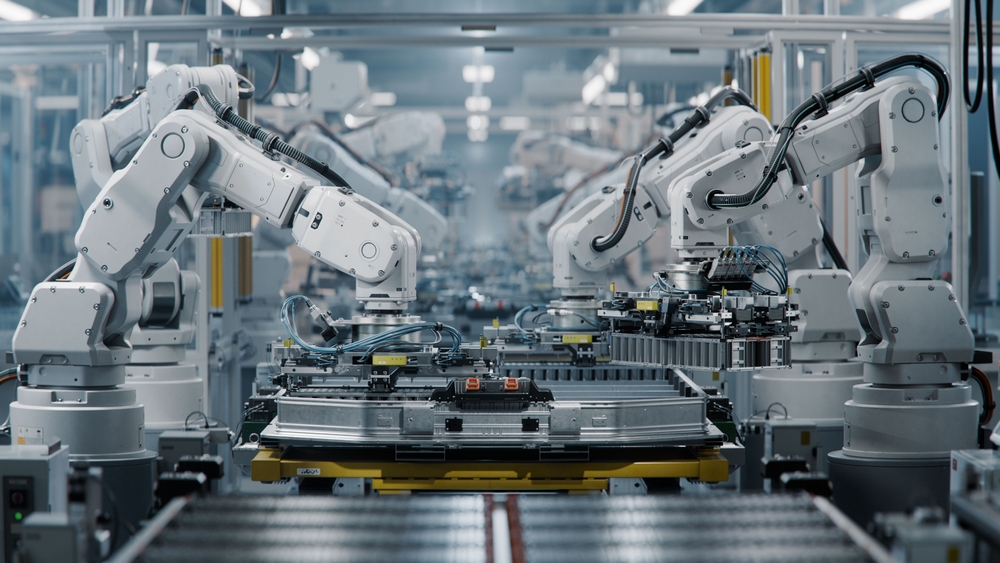
Peer into the factory floor in Bavaria or Ohio and you'll see similar hardware – mechanical arms, automated pickers, AI driven sensors and a host of other sci-fi looking components.
So, what's the difference?
Although the what is similar, the why and how behind it diverges significantly depending on which side of the Atlantic you find yourself.
What are Europe's automation goals?
Europe faces very different challenges to China or the US. Since 2022, when the supply of cheap Russian gas dwindled, energy efficiency has been the biggest focus for European manufacturers.
Manufacturers across the continent are pairing automation investments with energy-monitoring systems that tie directly into production scheduling, shifting energy-intensive tasks to cheaper or greener parts of the day. This focus ties naturally with net-zero goals and Europe's general green initiatives. Siemens, for one, has cited a roughly 90% reduction in automation-related costs at its Erlangen plant in Germany after deploying AI-driven robots for parts picking and placement – exactly the kind of efficiency gain that also cuts energy use per unit produced. (EuropeanCapitalInsights, 2026)
But it's not all about energy costs. European workers and those governing are keen to keep people on the factory floor. To do that, automation has taken on a collaborative hue, plants investing in cobots to augment human capabilities instead of replacing them. (RoboticsCenter, 2026)
Another interesting theme for Europe is the creeping labour shortages, particularly in fast-growing segments like pharma and bio-tech – now the fastest-growing end-user segment in European factory automation, expanding faster than any other industry as manufacturers chase precision, traceability and contamination control. An aging technically skilled workforce is being partially replaced with automation. Acute requirements like precision, traceability, and contamination control lend themselves to advanced automation, although EU governance and workers unions mean full automation is unlikely. (MordorIntelligence, 2026)
What are US automation goals?
Reshoring, technological sovereignty and future predictions guide US automation despite a concerning labour gap.
The CHIPS and Science Act and the Inflation Reduction Act laid the initial groundwork for reshoring technical supplies – namely semiconductors, EV batteries, solar components and other compute elements – and a subsequent slew of combative tariffs has since intensified that push. Electrical equipment (largely EV batteries and solar components) and computer/electronics manufacturing (largely semiconductors) together accounted for roughly two-thirds of all announced US reshoring jobs in 2024, and 88% of those reshored jobs were classified as high-tech or medium-high-tech – meaning they arrive already built around heavy automation rather than manual assembly. (Kore1, 2026)
Ambitions for full automation or even China-like dark factories mark out pure efficiency as a clear number one goal. Cheap energy and colossal capital investment makes it possible, although not without risk. US manufacturing is building and automating for capacity which doesn't exist yet.
Circumnavigating labour shortages is another driver of full automation. Newly automated plants are regularly built in locations devoid of existing technical workforces. US manufacturers face a projected need for 3.8 million additional workers by 2033, with an estimated 1.9 million of those roles at real risk of going unfilled. Automating quickly is the US answer to an impending labour crisis – some reshoring consultants now advise designing new US plants for 30–40% fewer direct labour roles than an equivalent facility built a decade ago. (TheRobotReport, 2026)
Another uniquely American side to the automation story is humanoid robotics. Unlike traditional robotics, designed to complete one or two tasks with precision, humanoid robots are seen as generalists. Real industrial pilots exist: Figure's robots logged over 1,250 operational hours handling sheet-metal parts at BMW's Spartanburg plant (a European automaker's US facility, notably), loading more than 90,000 parts across an 11-month deployment that supported production of over 30,000 BMW X3 vehicles at greater than 99% placement accuracy. Agility's Digit has completed similar pilots elsewhere in the industry. (Figure, 2026)
But the coverage-to-reality gap is wide — even Tesla's own CEO acknowledged on the company's Q4 2025 earnings call that Optimus units were "not in usage in our factories in a material way," used mainly for data collection rather than production. (WebProNews, 2026)
Outlining the Differences: US & EU
It's not the technology that's different, it's what they're used for:
| EUROPE | US | |
| Primary driver | Energy costs, aging workforce, regulatory pressure | Reshoring incentives (CHIPS Act, IRA), labor shortages, geopolitical decoupling |
| Automation adoption | 267 robots per 10,000 workers (Western Europe, 2024) – EU-27 average 231 | 307 robots per 10,000 workers (2024) – 8th globally |
| Preferred automation style | Collaborative robots, human-augmenting | Full automation / lights-out where feasible, fixed and mobile robotics at scale |
| Framing | "Industry 5.0" — human-centered, sustainability-linked | Efficiency- and capacity-first; humanoid robots as a speculative bet |
| Leading sector | Automotive (Germany, 449 robots/10,000 workers), growing pharma/biotech | Semiconductors, EV batteries, electronics – ~66% of 2024 reshoring jobs |
| Regulatory posture | EU AI Act and Machinery Regulation set explicit safety rules | Lighter-touch, incentive-driven (tax credits, grants) rather than rule-driven |
One of the biggest shared concerns remains about labour shortages. Sometimes these are overcome through automation, although that is often a mid-long-term solution. But for those searching for solutions now, it remains critical to work with a partner who can source the best and brightest.
If you're looking for expertise in STEM and can't wait for an automated fix, schedule a call today. With a decade of hands-on experience and a global work bench of the world's best, CMC can deliver the right expertise when and where you need it most.
FAQs
Is Europe or the US more automated?
It depends how you measure it. As a bloc, the EU-27 averages 231 robots per 10,000 manufacturing workers, and Western Europe as a region leads the world at 267. But the US alone actually outranks that EU average, at 307 robots per 10,000 workers (8th globally) - a gap that's really explained by Germany's outsized 449 pulling the European figure up, not broad adoption across the whole continent.
Why is Europe focused on collaborative robots instead of full automation?
Two main reasons: energy costs and workforce politics. Since losing cheap Russian gas in 2022, European manufacturers have prioritized automation that cuts energy use per unit – Siemens' Erlangen plant, for example, cut automation-related costs by roughly 90% using AI-driven robots. At the same time, European workers and regulators want people kept on the factory floor, so plants favor cobots that augment workers rather than replace them, reinforced by frameworks like the EU AI Act and Machinery Regulation.
Are humanoid robots actually working in US factories yet?
Mostly not in production, despite the hype. The clearest real-world case is Figure AI's robots at BMW's Spartanburg plant, which logged over 1,250 operational hours and loaded 90,000+ parts across an 11-month pilot with over 99% accuracy. But even Tesla's Elon Musk admitted on the company's Q4 2025 earnings call that Optimus units were "not in usage in our factories in a material way" - they're mainly being used for training data, not actual production work.
References
American Industrial Magazine. (2026). U.S. manufacturing statistics 2026: Output, jobs, wages & reshoring data. https://www.americanindustrialmagazine.com/blogs/industry/u-s-manufacturing-statistics-2026-output-jobs-wages-amp-reshoring-data
BMW Group. (2026). BMW Group to deploy humanoid robots in production in Germany for the first time [Press release]. https://www.press.bmwgroup.com/global/article/detail/T0455864EN/bmw-group-to-deploy-humanoid-robots-in-production-in-germany-for-the-first-time?language=en
Center for Strategic and International Studies. (2026, May 22). Reshoring semiconductor manufacturing: Addressing the workforce challenge. https://www.csis.org/analysis/reshoring-semiconductor-manufacturing-addressing-workforce-challenge
Design Engineering. (2026, April 9). Robot density surging across the globe: International Federation of Robotics. https://www.design-engineering.com/robot-density-surging-across-the-globe-international-federation-of-robotics-1004048306/
European Capital Insights. (2026, April 2). Europe's AI push faces major roadblock: High energy costs threaten industrial competitiveness. https://europeancapitalinsights.substack.com/p/europes-ai-push-faces-roadblock-high
Figure AI. (2025, November 19). F.02 contributed to the production of 30,000 cars at BMW. https://www.figure.ai/news/production-at-bmw
iFactoryApp. (2026, June 13). Reshoring manufacturing in 2026: New US factory investment guide. https://ifactoryapp.com/greenfield-consulting/reshoring-manufacturing-new-us-factory-investment-guide
International Federation of Robotics. (2026, April 8). Robot density surges in Europe, Asia, and Americas. https://ifr.org/ifr-press-releases/news/robot-density-surges-in-europe-asia-and-americas
KORE1. (2026). Reshoring in 2026: US manufacturing jobs comeback. https://www.kore1.com/reshoring-manufacturing-jobs-2026/
Mordor Intelligence. (2026, January 16). Europe factory automation and industrial controls market report. https://www.mordorintelligence.com/industry-reports/europe-factory-automation-and-industrial-controls-market
Robotics Center of Silicon Valley. (2026). State of robotics 2026 — European Union. https://www.roboticscenter.ai/state-of-robotics-2026-european-union
The Global Economics. (2026, May 15). Germany 2026: Reinventing the industrial giant. https://theglobaleconomics.com/2026/05/15/germany-industrial-giant/
The Motley Fool. (2026, January 28). Tesla (TSLA) Q4 2025 earnings call transcript. https://www.fool.com/earnings/call-transcripts/2026/01/28/tesla-tsla-q4-2025-earnings-call-transcript/
The Robot Report. (2026). MISUMI Americas releases reshoring report, supports manufacturing training bill. https://www.therobotreport.com/misumi-americas-releases-reshoring-report-supports-manufacturing-training-bill/
WebProNews. (2026, July). Elon Musk confronts the brutal reality of building Optimus at scale. https://www.webpronews.com/elon-musk-confronts-the-brutal-reality-of-building-optimus-at-scale